Kostenloses 20 minütiges Erstgespräch



Understand Depression
Depression is a word that many of us use. But do we really know what it means and what lies behind it? Just to be clear from the start, there are big and important differences between "I've been feeling depressed the last few days" and clinical depression. Today, I want to clear up these misconceptions.
Sebastian Görne
7/9/202615 min read
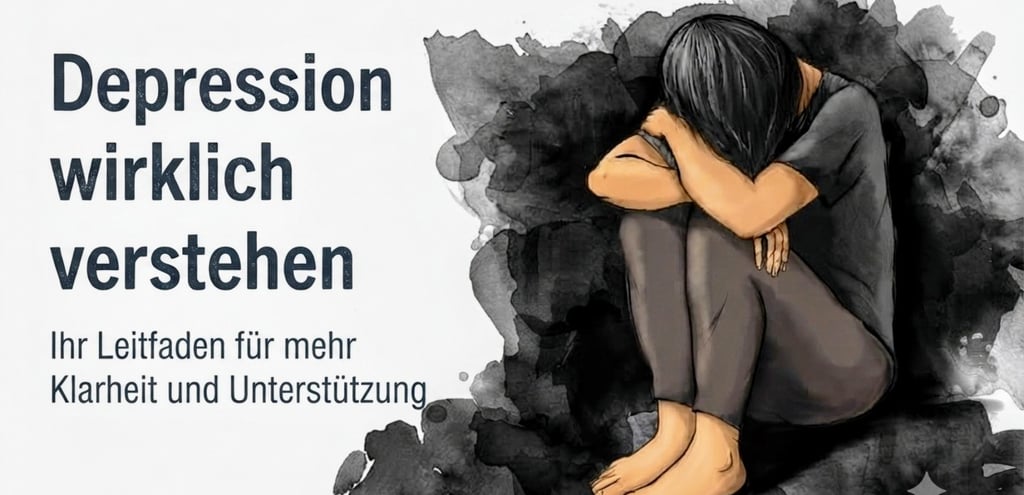

Depression? What does that actually mean?
We have all heard it from the people around us: "I feel depressed..." or "I think I have depression..." Perhaps you have even thought to yourself that you had or have one. In our daily lives, we frequently use the term "depression" to describe a feeling of dejection or sadness, and the people around us understand what we mean; it serves to convey to others what we are currently experiencing emotionally.
However, there is a difference between "I have been feeling dejected and sad for a few days" and clinical depression. Days and phases in our lives where we experience more sadness and dejection are part of normal human experience. Sometimes the sun shines, and sometimes it is grey and rainy for a few days—these are normal fluctuations and are a part of life. But when does it become a true, clinical depression and reach the threshold of illness?
Where does the difference lie?


When we suffer from a normal depressive mood, it often has rather limited effects on our lives. Yes, we feel a somewhat depressed mood for ourselves in certain areas of our lives and we experience a feeling of sadness. Perhaps this feeling even lasts for a few days before our usual mood returns. In general, we are still able to lead our lives normally and meet the demands that life places on us—even if with a certain heaviness.
In contrast, depression runs deeper; it affects our view of ourselves and is all-encompassing. It is accompanied by a loss of interest and pleasure in things that were previously experienced as enjoyable. This means our hobbies and time spent with friends simply no longer bring us joy. This is a depressive state that affects all areas of our lives. Those affected frequently complain of a lack of drive and increased fatiguability. Depression is usually accompanied by a loss of self-confidence and self-esteem, and can lead to self-reproach and feelings of guilt. It is not uncommon for the entire meaning of one's life to be questioned, and suicidal thoughts are also a frequent accompaniment.
As you can already see, depression has a different dimension and severity. Aside from our emotional world, depression also affects our body and our mental performance, manifesting, for example, in sleep disorders, loss of appetite, loss of libido, early morning awakening, and a morning low (Morgentief) that makes it difficult for those affected to cope with the demands of everyday life at all.
Depending on the number of symptoms reported by a sufferer, a depressive episode is classified as mild, moderate, or severe, and treatment is also guided by the severity of the depressive episode. While a mild depressive episode is usually treated without medication, medications are frequently used as supportive treatment in moderate and severe depressive episodes. More information on that later.
How does depression develop?
Now we know what defines depression, but how does it happen that we slip into a depression? There are many different explanatory approaches to this, and I believe that there is not just a single cause, but rather an interplay of various factors and circumstances coming together. Here, I will try to give you an overview of what I consider to be the most important explanatory models and factors:
The Bio-Psycho-Social Model
The Reinforcement Loss Theory according to Peter Lewinsohn
The Cognitive Model according to Aaron T. Beck
The Learned Helplessness Model according to Martin Seligman
The Psychoanalytic Model
The Bio-Psycho-Social Model
In contrast to many other explanatory models, the biopsychosocial model states that depression does not arise mono-causally, but is the result of various factors. It relies on three pillars.
The biological level (the physical level): This pillar looks at the physical hardware we are equipped with. Things like genetic predispositions—since mental illnesses also run in families—as well as hormonal influences, chronic illnesses, etc., can contribute to depression. I think we can understand this: when we are physically impaired, we also feel more vulnerable to the challenges of our daily lives.
The psychological level (Mind & Psyche): Here we take a close look at things such as thought patterns, individual coping strategies, personality traits, and also the way someone processes emotions. As you can certainly imagine, someone with a fundamentally negative attitude is more vulnerable to depression than someone who has a positive outlook on life. Of course, many of these things are a direct consequence of how we grew up and how we learned to interact with the world.
The social level (The environment): A saying goes, "Show me the 5 people closest to you and I will tell you who you are." Our environment shapes us and has a major influence on who we are and how we see the world. At this level, we look at your relationships with partners, family, and friends, what things look like at work right now (stress, bullying, etc.), but also life events that could have an impact, such as divorce, deaths, job loss, etc. Your life situation has a major impact on your emotional well-being.
All of these areas interact with one another; for example, a chronic illness will likely also impact your social level by impairing your work and perhaps your relationships and hobbies. As a result, you find yourself entangled in negative thought patterns (psychological level), etc. As you can see, a change in one area can lead to changes in other areas. This applies to the downward spiral into depression, but also to the upward spiral out of depression that we can utilize in treatment. When we turn a single screw, we trigger a change throughout the entire system. But more on that later in the section "The Way Out of Depression."


The Reinforcement Loss Theory according to Peter Lewinsohn


The reinforcement loss theory is based on the assumption that life comes down to maintaining a healthy balance between things that bring us joy or give us strength, and the demands and challenges of everyday life. Life demands a lot from all of us, and we all know the feeling that life can be a sequence of continuous challenges. According to Lewinsohn, it is essential to have a counterweight to these burdens. These so-called positive reinforcers should act as a counterbalance and, ideally, outweigh everyday stress.
So that we can draw strength from our lives. However, there are naturally a variety of events that can disrupt this balance—loss of a job or health, divorce, or the loss of a loved one, failing health that no longer allows us to pursue our beloved hobbies, and so on. Now, if our scales fall out of balance and the stress of daily life takes over for an extended period without us being able to create enough offset, we become more vulnerable to mental illnesses, particularly depression, as life no longer holds much joy for us. In short, our lives should predominantly bring us joy and give us strength.
The Cognitive-Modell by Aaron T. Beck


Aaron T. Beck is one of the co-founders of Cognitive Behavioral Therapy. Aaron T. Beck observed that his depressed patients all had something in common, namely a tendency toward a negative thinking style. Compared to healthy individuals, his depressed patients tended to view themselves, the events in their lives, and the future in a negative light. This is also known as Beck's Cognitive Triad, which is characterized by a negative view of oneself, the environment, and the future.
These negative thoughts are also called dysfunctional thoughts. According to Aaron T. Beck, depressed patients are characterized by a dysfunctional core belief structure that maintains depression. If we constantly interpret ourselves and our environment negatively and can see no hope for improvement, this will keep us trapped in our depression. According to Beck, we must change the thought patterns of a depressed person, because once we manage to break out of these negative thought patterns, we can also escape the depression.
Die erlernte Hilflosigkeit nach Martin Seligmann


Martin Seligman and his colleague Steven F. Maier conducted an experiment with dogs in which they divided the dogs into three groups. The control group was locked in a cage and released after some time. The second group was locked in a cage where they were subjected to electric shocks; however, these dogs had the ability to stop the shocks by pressing a lever, learning that they had control over the shocks. The third group was also subjected to electric shocks, but unlike the second group, they had no way to stop the shocks.
All three groups were then placed in a box divided into two compartments. On one side, the floor was electrified with shocks, while the other side was normal and provided safety from the shocks. The two sides were separated by a low barrier, allowing the dogs to easily jump from the electrified side to the safe side. The result was that the dogs from the first and second groups immediately fled to the safe side, as they had learned that they had control over their fate. Not so for the third group—the dogs in the third group remained passive on the electrified side, even though they could have escaped the pain with minimal effort. They surrendered to their fate. From their previous experience, they had learned that they were helpless, and even though this was now a different situation, the dogs generalized their previously learned helplessness to the new context. This gave rise to the concept of learned helplessness.
It was subsequently shown that humans with such learned helplessness also have a higher vulnerability to depressive episodes. Many depressed individuals feel that they cannot change anything and that they are victims of their circumstances. It turned out that a sense of self-efficacy is a vital component of our mental health. When we feel that we have control and influence over our lives and direction, it fills us with confidence and strength—unlike individuals who feel helpless and at the mercy of their environment.
The Psychoanalytic Model according to Sigmund Freud
According to Sigmund Freud, depression primarily arises from an unprocessed loss where the subsequent aggression is turned inward. This happens particularly often in people who have not learned how to express their anger and aggression, leading them to suppress these perceived negative emotions.
The exact psychological process can be broken down into the following steps:
Real or Symbolic Object Loss: It begins with the loss of a loved one, an important key figure, or even an abstract ideal (such as status, health, or life goals).
The Ambivalent Relationship: There was always an unconscious ambivalence toward this lost "object"—meaning that alongside deep love, there was also suppressed anger, disappointment, or resentment toward that person.
Introjection (Internalization): Since the object is now gone, the unconscious refuses to accept the loss. Instead, the lost object is introjected within the psyche—essentially rebuilt inside the self ("Ego"). One identifies with it.
Turning Aggression Inward (Autoaggression): The unconscious anger and resentment originally meant for the lost person can no longer be directed at them (because they are gone or deceased). However, since the Ego has now merged with the introjected object, the axe of anger suddenly strikes one's own self.
The Result: The accumulated aggression turns into autoaggression. This leads to the typical symptoms of depression: massive self-reproach, extreme feelings of guilt, self-devaluation, and the feeling of being worthless. Freud aptly called depression (melancholia) a "rage directed against one's own self," in which the shadow of the lost object has fallen upon the Ego.
Based on this model, it is essential for depressed patients to reconnect with their suppressed anger and learn to develop a healthy way of dealing with it. Here, the focus lies on expression: these suppressed feelings must be brought out of the shadows. They must be given space and room to breathe to unburden the system.
And now what? What can we do?
Well, now that we have a better understanding of the path into depression, the question arises: what can we do to get out of depression again?
First of all, I would like to say that the goal should not be directed backward, but forward. Often we want to go back to a happier moment in our lives, which is understandable because it is easier to remember a joyful moment in our past than to imagine a possible future—especially during a depression, when we are already struggling with hopelessness.


However, we must direct our gaze forward and let the past be the past; it is a place to which we cannot return. This does not mean we have to forget it; on the contrary, we should remember and learn from it, and if possible, see it as motivation for our future.
Now, the path out of depression looks different for every individual and also depends on what the main triggers of the depression were. All the approaches that follow depend on the individual situation in which the person finds themselves, and not every approach suits everyone.
Step by step out of depression with the right help
Even though I believe we can accomplish a lot on our own, I still advise seeking professional support. Especially during a depression, those affected lack motivation and drive, and a first step should be to enlist the help of a therapist. A therapist can help create an individualized therapy plan and stay on track, as it is often difficult for sufferers to return to action and self-efficacy. Furthermore, simply admitting to oneself that help is needed often provides relief.
The Physical Level
Sports and exercise as an antidepressant have proven to be very helpful for sufferers. Physical activity has a multitude of physiological effects. It boosts the release of neurotransmitters such as endorphins (the body's natural painkiller, leading to serenity), dopamine (the reward hormone, leading to more drive), serotonin (the mood-balancing hormone), and noradrenaline (increasing alertness and attention), all of which lead to a general rise in mood. In addition, exercise boosts neuroplasticity and brain growth, allowing the brain to better store new positive experiences and break down negative wiring. Additionally, exercise serves as a stress reliever and reduces cortisol and adrenaline levels. And finally, we must not forget that a changed reflection in the mirror can also help us develop more self-confidence. When we like what we see in the mirror, it also contributes to our motivation.
A healthy diet must not be underestimated. Researchers even assume that our modern diet of ultra-processed foods contributes to our mental illnesses. These foods not only lead to obesity due to their high caloric density, but also to chronic inflammation in our bodies, and chronic inflammation in particular has been linked to depression. Healthier and unprocessed foods give our body a variety of nutrients and the fuel we need every day to manage our daily lives.
Sleep and rest: When we sleep and rest (and rest does not mean staring at a phone or other media), our body can repair itself, flush out accumulated waste products, and process the events of our day. We need time for rest and recovery as a counterbalance to the constant challenges of our lives. If we do not get this time, our body remains in a permanent state of stress, which leads to an increase in stress hormones and an increase in chronic inflammation, which, as mentioned earlier, can contribute to depression.
The Psychological and Mental Level
As I mentioned earlier, depressed people exhibit negative and dysfunctional thought patterns regarding themselves, their environment, and the future (Beck's Cognitive Triad). This is especially where the support of a psychotherapist comes into play. Together, the sufferer and the therapist can analyze and question these thought structures and replace them with functional thoughts. "The happiness of your life depends upon the quality of your thoughts." — Marcus Aurelius Our thoughts have a decisive influence on our lives and how we interpret the events within them. If we manage to positively influence our thoughts, our lives will also change for the better. Greater serenity and optimism make it easier for us to deal with other people and lead to a general reduction in stress. Every thought is a choice, and when we choose to think positively and constructively, we regain a sense of self-efficacy rather than feeling like a victim of our thoughts.
Meditation and journaling serve as methods of relaxation and pathways to greater self-awareness. Through meditation, we learn to observe and accept without needing to change things. Meditation unmasks thoughts for what they are: mere thoughts. They have no power over us unless we give them that power. It is about learning to see our thoughts for what they truly are: they are objects—like clouds passing across the sky. But they are not the sky; you are the sky. If we do not identify with the clouds, but instead with the sky, we see them for what they are. They pass by, they dissolve, but you are the constant—the sky. Only when we assign them more meaning do they gain power over us. Meditation and journaling bring light into the corners of our unconscious and help us discover what we need to feel good again.


The Social Level
As humans, we are social beings; community gives us security and a sense of safety. Being together with others reduces stress and releases the hormone oxytocin. Oxytocin is the so-called bonding hormone—it promotes feelings of connection, safety, and belonging, thereby contributing to our well-being. At the same time, it acts as an antagonist to stress, reducing anxiety and lowering cortisol levels (the stress hormone).
Since depressed individuals generally tend to withdraw socially, those affected experience a deficiency of this important hormone. This points to a crucial aspect in the healing of depression: despite a lack of drive, those affected must try to become socially active again. Social isolation fosters depressive episodes, and vice versa, meaning that social integration should be a powerful and necessary component in healing from depression.
Of course, there are a variety of ways to become socially active again:
Pursue a hobby that involves other people, such as group sports. This allows you to kill two birds with one stone: social integration and exercise.
Any type of group activity has the described effects, whether it's art classes, a choir, dance lessons, group language courses, cooking classes, etc. The list is long, and I am sure there is something for every taste.
Reach out to old friends and meet up for a beer, coffee, dinner, or whatever it may be. Friendships are an important foundation for our health.
Traveling and discovering new people and cultures can also be an excellent method. It might help some people to go places where no one knows them and where the environment doesn't remind them of their situation and problems.
Every interaction with others can be beneficial; it allows us to take a break from our own thoughts and makes it possible simply not to shine the spotlight on our worries, letting those worries rest for a bit. This in no way means we should ignore our worries or fall into permanent avoidance, but we do need breaks and some distance. This way, we can return to face our challenges later with a fresh perspective and renewed energy.
The Mix Makes the Medicine
To experience healing, I believe it comes down to working holistically and examining all aspects of life. A multimodal approach, where we combine different therapeutic methods, has a better prognosis for recovery than pure psychotherapy alone. Therefore, I always recommend a combination of the possible approaches mentioned above. Furthermore, it is always important to tailor a therapy plan individually and holistically to each person. The right approach is the one that shows results, not the most modern or the most popular one. This is different for every individual.
Ultimately, the information above is only a small slice of a massive topic that still requires a great deal of research. However, about 15–20% of all people suffer from depression at least once in their lives, and it is very likely that we all have someone in our lives who either suffers from depression or has suffered from it in the past. My intention with this blog is to create more understanding and acceptance for those who suffer from depression and for their loved ones. None of us are immune, and the more we know, the more we can do to protect ourselves against a potential depression or to help those around us.
I hope that this information was helpful and could give you a better understanding of what depression is. Thank you for making it this far, and should I have written anything incorrect, I would appreciate your feedback by email so that I can look into it.
Medication as Support
(Important beforehand: I am not a physician and am therefore not authorized to give recommendations regarding medication; this is merely information about pharmacological options and their use. If you are considering medication, you should and must always do so in consultation with a specialist.)
For people suffering from depression, medication can be a supportive tool. According to the S3 guidelines, treatment with antidepressants is indicated for moderate and severe depression.
Antidepressants are generally used in combination with psychotherapy and can support the healing process. The most commonly used antidepressants are SSRIs (Selective Serotonin Reuptake Inhibitors). They increase serotonin levels in the synaptic cleft in the brain; based on the serotonin hypothesis, this increased serotonin level leads to an improvement in the patient's mood. Serotonin is also referred to as the feel-good or happiness hormone. Therefore, the assumption is close at hand that more serotonin leads to an improvement in mood.
Whether treatment with antidepressants is appropriate or necessary is at the discretion of a medical specialist and not up to me as a Heilpraktiker für Psychotherapie (psychotherapeutic practitioner). However, I find this topic very exciting, especially the new findings in neurobiology that are calling the old serotonin hypothesis into question.
Should you be interested in more details on this, I will either write a bonus section at the end of this blog or a separate blog post.
Contact
Feel free to write me an E-Mail or Call me for any question or to arrange an appointment.
Mobil
+49 0152 568 552 37
© 2025. All rights reserved.




Member of VFP: